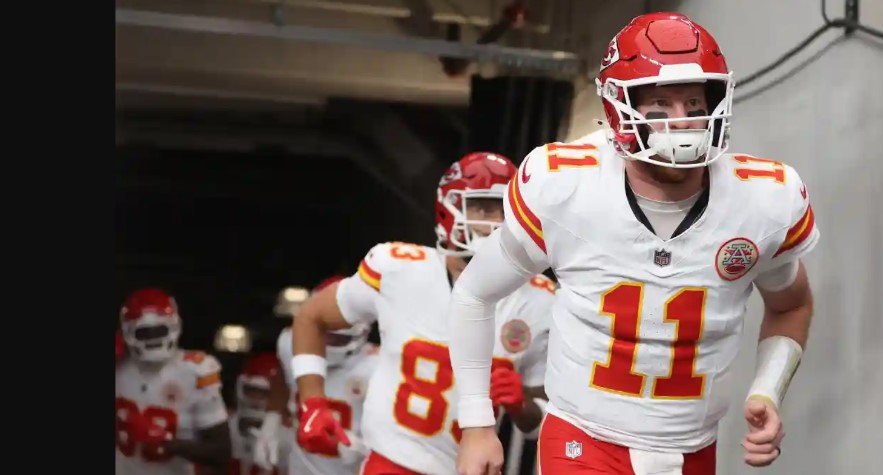
When the Philadelphia Eagles take the field on Sunday, they’ll face a quarterback on the other sideline who, by default, is responsible for the endless layers of talent, winning culture, and high character that will be on full display for more than 130 of the 195 countries watching.
Two years ago, as the Eagles were preparing to face the Kansas City Chiefs, Birds’ General Manager Howie Roseman finally opened up about his obvious disdain for his former franchise “savior” in Kansas City’s backup quarterback, Carson Wentz.
History will likely label the Wentz era in Philadelphia as a failure, but it certainly didn’t start that way. Wentz, in just his second season, was the favorite for the MVP award, leading the Eagles to an 11-2 record before tearing his ACL in a win over the Rams in week 13.
But things went downhill from there, mainly due to Wentz’s inability to stay healthy. His lack of durability led Roseman to draft Jalen Hurts in the second round of the 2020 draft, just one year after the Eagles and Wentz agreed to a four-year, $128 million extension.
“We were making sure we had depth,” Roseman said during Super Bowl week in 2022. “At that time, Carson had played a total of 12 snaps in six playoff games.”
At the time, it seemed like a questionable move given the Eagles’ other roster needs and the large investment already made in Wentz. The Eagles had sacrificed significant assets to draft Wentz with the second overall pick in 2016, and he had been an MVP candidate in 2017.
But then Hurts arrived—calm, confident, and capable. He had led Alabama and Oklahoma to three College Football Playoff appearances, reaching the title game twice.
Wentz had a million-dollar arm but a 10-cent head. He couldn’t handle being overshadowed by backup Nick Foles in Super Bowl 52, and the looming presence of Hurts only worsened his insecurities, which played out on the field. Wentz started the first 12 games of 2020 but was benched at halftime of Game 12 against Green Bay. He never played another snap for the Eagles. Wentz finished with a 3-8-1 record that season and was statistically the worst quarterback in the NFL.
Roseman traded Wentz to the Colts after the 2020 season, swallowing an NFL-record $33 million salary-cap hit for 2021. Meanwhile, he moved forward with a quarterback who lacked Wentz’s raw arm talent but had an unshakable mindset and a spine of steel.
Wentz’s career since then has justified Roseman’s decision to part ways with “Ginger Jesus.” The following year, Wentz struggled with the Colts, losing his last two games while needing only one win to secure a playoff spot: a three-point home loss to the Raiders and a 26-11 defeat to a 3-14 Jacksonville team in the season finale. Colts’ owner Jim Irsay was so frustrated with Wentz that he traded him to the Commanders that offseason. There, Wentz’s play further declined; he got injured (no surprise), returned, but was benched for the season finale. It’s likely he won’t see another NFL start. He did start the Chiefs’ meaningless season finale this year, completing 10 of 17 passes for just 98 yards in a 38-0 loss to the Broncos.
Hurts, meanwhile, will be starting in his second Super Bowl in the last three years this Sunday.
“Our job is to bring in as many good players as possible,” Roseman said. “If you’re not better than the guy we drafted, how are you going to be better than the best players in the league?”
But rebuilding a team from the ground up in just two seasons takes more than just a steady quarterback.
Roseman traded Wentz to the Colts after that 4-11-1 season in 2020, receiving a 2021 third-round pick and a conditional second-round pick for 2022. That conditional pick became a first-rounder when Wentz played over 75% of the Colts’ snaps that year.
Roseman pulled off one of his best-ever trades by converting the draft capital from the Wentz deal into a series of moves that set the Eagles up for long-term success. His aggressive tactics transformed the Eagles’ roster into a Super Bowl contender for years to come.
What the Eagles received from the Wentz trade included: DeVonta Smith, A.J. Brown, Kyron Johnson, Jalen Carter, Cooper DeJean, Jalyx Hunt, Jeremiah Trotter Jr., and future draft picks.
What the Colts received: Carson Wentz, Matt Pryor, Alec Pierce, Jelani Woods, Bernhard Raimann, Andrew Ogletree.
The Saints, involved in the trade, received: Chris Olave, Trevor Penning, and Jordan Jackson.
The Eagles clearly won the trade, with Brown, Smith, and Carter as the centerpieces and DeJean impressing as a rookie corner. The Colts moved on from Wentz after just one season, banking on four draft picks from the 2022 draft to salvage the deal.
The Saints gave up multiple assets for three draft picks, ultimately sending eight picks for two first-rounders and a sixth-rounder in 2022. Olave has been stellar, but Penning has struggled.
Roseman is the fourth NFL GM in the salary-cap era to build three Super Bowl teams with the same franchise—and he did it with two different head coaches and multiple quarterbacks. He deserves immense credit for turning what seemed like a quarterback disaster into the most talented team in the NFL, establishing an infrastructure for sustained success. His relentless pursuit of excellence has created a juggernaut in Philadelphia, positioning the Eagles for continued Super Bowl contention for many years to come.
Leave a Reply